Straight Stitch is shown as single, spaced stitches worked either in a regular or irregular manner.

Sometimes the stitches are of varying size. The stitches should be neither too long nor too loose.

stem stitch

Stem stitch is one of the most popular outlining stitches.

You can use this stitch to utline flowers or to fill an area, unshaded leaves, and arabesque, and all conventional designs.

Continue reading…

satin stitch

Work Straight Stitches across the shape as shown. If desired, Chain Stitch or Running Stitch may be worked first to form a padding underneath, to give a raised effect.

Continue reading…

3928882208_99d76920c7

A running stitch can be used for straight and curved lines, for outlines, as a quilting stitch, as a gathering stitch for smocking, and as a foundation for other stitches. This is one of  the few embroidery stitches where several stitches may be made at once, by running the needle in and out of the fabric.

Continue reading…

Pekinese Stitch

Pekinese Stitch is also known as Chinese Stitch.  It was worked using silk  canvas, on a small scale, row upon row in blended shades to fill shapes.

Continue reading…

This form of Satin Stitch is so named as all the stitches are of varying lenghts. It is often used to fill a shape which is too large or too irregular to be covered by Satin Stitch.

This Long and Short Stitch is also used to achive a shaded effect, as shown. In the first row the stitches are alternately long and short and closely follow the outline of the shape.

In the following rows long and short stitches are worked to give a smooth texture.

french knot

Knotted Stitch or French Knot is used for the centres of such flowers as the daisy or wild rose, and sometimes for the anthers of others. It isn’t very easy to be precise on the number of threads in the needle to work a French Knot. It depends on the effect you require and for that you will need to practise the stitch on a spare piece of canvas. I feel it is better to have a small number of strands in the needle and work more loops, for an airier effect.

Continue reading…

fern_stitch

Fern Stitch consists of three Straight Stitches of equal length radiating from the same central point (A). Bring the thread through at (A) and make a Straight Stitch to (B). Bring the thread through again at (A) and make another Straight Stitch to (C). Repeat this at (D) and bring the thread through at (E) to begin the next three radiating stitches. The center stitch follows the line of the design.

cable stitch

This Stitch is worked from left to right. Bring the thread through on the line of the design.

Insert the needle a little to the right on the line and bring the needle out to the left midway between the length of stitch and with the thread below the needle (A). Work the next stitch in same way but with the thread above the needle (B).

Continue working in this way, alternating the position of the thread. This stitch may also be worked over counted threads of even-weave fabric or canvas.

Backstitch is used for outlining a design or part of a design, to add detail or emphasis, or for lettering. It is usually indicated on a chart by solid lines with the shade code indicated on the chart or key. This stitch is added after the line being broken by the cross stitches.

Back Stitch can be worked by either skimming the needle through the fabric while holding it freely in your hand as shown here, or by stabbing the needle up and down in a hoop or frame. Continue reading…

assisi embroidery

Assisi Embroidery is a very charming Italian Embroidery, it’is simple to do and you can create decorative works.

Assisi stitching was named after St. Clare of Assisi, sister of St. Francis, Patron Saint of Needleworkers. It is worked mainly in cross-stitch and it reprenset a form of counted-thread embroidery based on an ancient Italian tradition where the background is filled with embroidery stitches and the main  motifs are left void i.e unstitched.

The name is derived from the Italian town of Assisi where the modern form of the craft originated. Continue reading…

Embroidery and Needlepoint threads come in a wide range of fibers and colours, each with its own special qualities.  Some can be used for lots of different types of embroidery; others are suitable for a particular purpose.

Continue reading…

Cross-stitch is very simple to do and it is a very relaxing hobby too, there is no need to know how to embroider or know embroidery stitches, you can do cross stitch by pdeveloping your imagination.

No limits in your creativity… you can embroider in any kind of linen or fabric. You can either work from prestamped items or from graphs, which is the most common.

Continue reading…

Welcome to my video embroidery lesson dedicated to all those who want to learn how to embroider and learn new embroidery techniques.

I begin the first embroidery lesson learning the most simple techniques of embroidery and then we ‘ll go to continue with the more complex.

Continue reading…


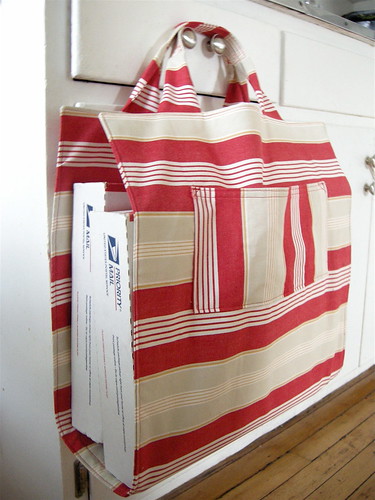
Tutorial To Create A Post Office Bag

August 7, 2008


Thank to Elsie Marlie to share tutorial for build a Post Office Bag. You can use that to put posts and other books!

Name (required)

Email (required)

Website

Speak your mind